Museum projects
Paimio's museums actively carry out a variety of projects in collaboration with partner organisations to develop and enhance museum services and activities.
-
During 2025–2026, Paimio Local History Museum is undertaking a project to renew its permanent exhibition while making it more accessible both in terms of content and the visitor experience. The project has received financial support from the Finnish Heritage Agency.
-
During the autumn of 2023, Paimio electrical museum carried out the Educational Afternoons at Paimio electrical museum project with financial support from STEK – the Electrical Safety Promotion Centre Finland.
Over the course of the autumn, the museum welcomed 12 groups of Year 5 and 6 pupils from primary schools across Southwest Finland. During the two-hour visits, pupils learned about electricity generation and distribution, as well as the safe use of electricity. The educational programme was delivered by a team of volunteers from Sähkömuseoveljet ja -sisaret (”The Brothers and Sisters of the Electricity Museum”), the volunteer organisation supporting the museum. In addition to the educational programme, each visiting group received a light snack and free bus transportation.
In April 2024, STEK awarded further project funding for the autumn 2024 programme, enabling eight additional school groups from Southwest Finland to visit the museum.
In April 2025, STEK awarded Paimio electrical museum a three-year project grant for 2025–2027. Funding for the final two years is conditional upon the continued development of the museum’s educational activities.
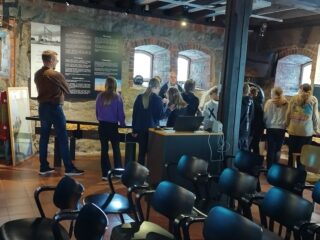
School pupils and their teachers exploring the museum’s scale model illustrating the generation and distribution of electricity. -
In 2021, Paimio Local History Museum carried out the Museum on the Move – Culture in Motion project, which improved the visibility and accessibility of the museum buildings through new information panels and mobile guides. The project received more than €12,000 in funding from Leader Varsin Hyvä. It supports both the accessibility of cultural heritage and the long-term preservation and use of the museum buildings.
You can explore the mobile guides created as part of the project. (only in finnish)
-
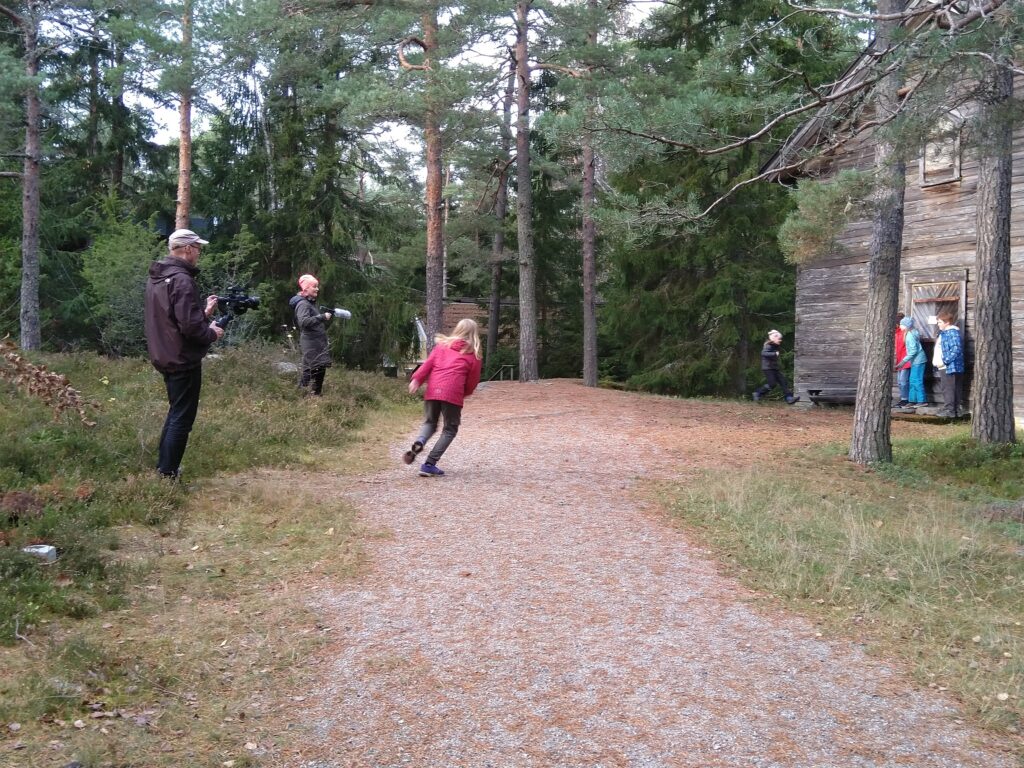
In 2021, the Electrical Museum Foundation carried out the Leikkispitte project, which collected memories from people who had grown up in Paimio about the games they played as children and the places where they played. The project received a €4,800 grant from the Finnish Heritage Agency.
The Electrical Museum Foundation coordinated the project and acted as its lead organisation, while the implementation was carried out in broad local collaboration with various partners. The project’s results were presented through interactive play workshops and mobile play activities.
During 2021, Paimio electrical museum also hosted a travelling exhibition on children’s play, introducing traditional games and historic playgrounds.
-
Kärest pitäen – A Project to Document and Revitalise Local Craft Heritage (2017–2018)
Project website: https://karestpitaen.wordpress.com/ (only in finnish)
Objectives
The main objective of the Kärest pitäen project was to document and preserve traditional craft techniques and pass this knowledge on to future generations. The techniques were recorded through written documentation based on interviews and, whenever possible, through audiovisual recordings. Archive materials and previously conducted interviews were also used.
All interviews and audiovisual material were archived in the collections of Miila Craft Museum, ensuring that the material remains available for future research and public use.
Based on the material collected during the project, a publication and an exhibition plan were produced for inclusion in the museum’s next permanent exhibition. The aim was to highlight traditional crafts from different periods, particularly those of Southwest Finland. Both the publication and the exhibition present the making process of traditional crafts through photographs and written descriptions, while the exhibition also features original objects.
A second key objective was to strengthen awareness of Paimio and enrich the town’s tourism offering. The project also produced source material based on traditional crafts that local craft entrepreneurs could use when developing contemporary products inspired by local heritage. Recycling was a central theme throughout the project—from recycling ideas and traditional knowledge to reusing materials.
Public events formed an important part of the project. Memory-sharing sessions focusing on traditional crafts not only collected valuable oral history but also provided meaningful social activities for older participants. Meetings between craftspeople, often organised in connection with project events, created valuable networking opportunities for artisans who frequently work independently.
The project also organised open events such as workshops and lectures, where participants learned about traditional craft techniques and explored how they could inspire contemporary product design. Through these meetings and events, traditional crafts were brought into dialogue with present-day life.
The project’s total budget was €61,920.
Organisation
The project began in early 2017. Preparatory work and project management were led by Laura Lankinen (M.A.), who served as Project Manager. From 1 June 2017 onwards, Satu Rantala (M.A., Artisan) worked as Project Coordinator on a 50% basis.
The Friends of Miila Craft Museum and other volunteers participated in the project by assisting with the organisation of events. Their contribution was recognised as volunteer work forming part of the project’s matching funding.
During the implementation phase, the Project Manager and Project Coordinator were supported by a steering group consisting of the project staff, one or two representatives of the Board of the Lyyli Tuomola Foundation, and a representative of local craft entrepreneurs.
The book published as part of the Kärest pitäen project is available for purchase at Miila Craft Museum and Paimio Electrical Museum.